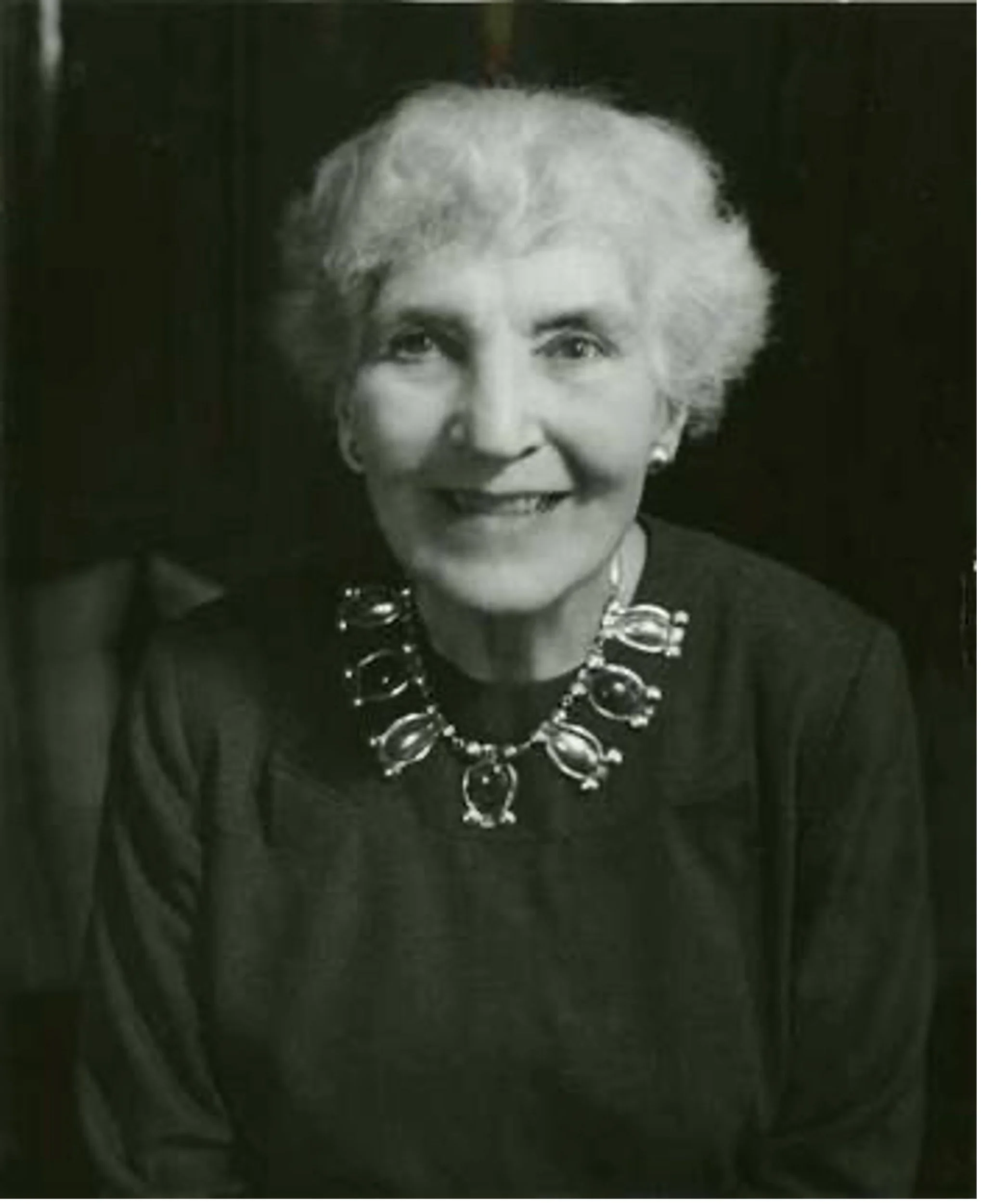
Ruth Murray Underhill
Courtesy of Jay Miller
Born into Quaker wealth at Ossining, on the east bank of the lower Hudson River just north of New York City, where her father was a lawyer, Ruth Murray Underhill (22 August 1883–15 August 1984) had two sisters (one a banker), a brother (Harvard professor and mountaineer), and an uncle in Classics. After Bryn Mawr prep, she studied comparative literature at Vassar, where she became Phi Beta Kappa. Instead of beginning marriage or teaching after her 1905 graduation (four years before Ruth Benedict graduated from Vassar), she went into social work for twenty years, initially on behalf of Boston immigrant children, then in New York while also managing the family farm. During her 1906–1908 grand tour of Europe, she took classes at the London School of Economics and the University of Munich, eventually gaining fluency in French, German, Italian, Spanish, and, later, Tohono O’odham, formerly called Papago.
During WWI, she worked for the Red Cross, wrote a column for the New York Sun, and experimented with writing for magazines and advertising. She managed an orphanage in Italy from 1918–1920 and wrote manuals on relief for war cripples in Italy and Germany. Her first novel, White Moth (1920), explored men and women in the workplace. Increasingly intrigued by the human condition, she left the New York courthouse after filing for divorce in 1930 from “wrong man” Charles Crawford and went up to Columbia University looking for a graduate career “to know about people,” discovering Ruth Benedict and anthropology. Her self-image as an older student was that of the great joy of a robin pulling a juicy worm out of the ground.
The ironic atonement of Ruth’s life’s work with Indians was her direct Puritan ancestor, John Underhill, butcher of the Pequots, who burned them and their fort in the 1630s, gaining control of the lucrative wampum trade. Survivors were forced to rename themselves Mohicans, one of whom was the anthropologist Gladys Tantaquidgeon, descendant of an Uncas deputy. If the subject ever came up, Ruth just said she had an ancestor “involved with Indians.” As a more subtle reminder, on her living room wall was the famous printed diagram of the fortified Pequot village.
Benedict had collected Tohono O’odham, then known as Papago, epics in 1927 from men, and George Herzog studied their music the next year, so Ruth Underhill concentrated on their kinship society and religious rituals during four field trips (1931–1934) for her 1939 dissertation, working with women, especially Maria Chona. When they discussed marriage, Ruth insisted, “Men were too much work,” while Maria described an eventful night: “I had never talked to a man at all and I did not know what to say; maybe I never would have talked to him [her new husband]; I do not know. Only one night when we went to bed, there was a rattlesnake in our bed. I screamed. He said, ‘Get up and we’ll shake out bedding.’ After that I felt more at home” (Papago Woman 1936:63).
In 1931, already in the field in Arizona, Ruth went to the Globe, Arizona, courthouse to testify briefly about anthropology’s graduate school requirement of fieldwork in the murder trial of an Apache man who murdered Columbia University graduate student Henrietta Schmerler on 18 July (Schmerler 2017). There was much discussion at Columbia as to whom would testify on the stand, with strong pressure on Ruth Benedict because Boas was in Europe. Underhill became the best solution as an older woman of impeccable family. The same day as her testimony, Underhill left for her own fieldwork at Sells, Arizona. The Apache was convicted and sent for life to McNeil Prison on an island in Puget Sound (paroled 19 August 1952, returned 26 October 1957, paroled 26 August 1963 but not sent to Arizona until November, fully discharged 30 March 1978, died 1980).
Columbia Anthropology survived the crisis, taking more care of female graduate students. At Barnard, the female equivalent, Ruth assisted Gladys Reichard, also considered for testimony, with the Hogan School, using Bureau of Indian Affairs funds to teach Navajos to write their own language. In 1935, after work as a Bureau of Indian Affairs applied ethnologist, Ruth was hired by the better-financed Soil Conservation Service, another aspect of John Collier’s Indian policy reforms, including a Papago constitution, drawn up by lawyers that she argued against as culturally inappropriate. Thereafter, she was banned from governmental consultations. Seconded to the Bureau of Indian Affairs in 1937, her curriculum materials developed into seven of the eight Indian Life and Customs series. As she relocated from Santa Fe to Denver as Supervisor of Bureau of Indian Affairs Indian Education (1942–1948), these included Indians of the Pacific Northwest (1945). Well illustrated with University of Washington Press images, each of its 20 chapters asked a basic question: Who are the Northwest Indians? What did they eat? What did they live in? What did they make? What did they wear? What was their home life? What was their government? What was their religion? Where are they today?
Over time, Ruth further developed these subjects into her overviews of Native North American cultures (Red Man’s America, 1953; with KRMA-TV’s 30 documentaries in 1956) and religions (Red Man’s Religions, 1965). Retiring from the Bureau of Indian Affairs in 1948, she began teaching at the University of Denver until forced out by age, then went around the world in 1952–1953, taught at State University of New York at New Paltz and Colorado Women’s College, and consulted on various projects. She, along with Marie Wormington, encouraged teenaged archaeologists Henry and Cynthia Irwin (Williams), who grew up in Denver and went on to Harvard, where Henry was featured in a Tom Lehrer song.
In Seattle, Ruth lived with Erna Gunther while collecting materials for the Northwest booklet. She was also writing a murder mystery to avenge misappropriation of her Papago materials by another scholar. Erna’s home had a spiral staircase between floors, and she recalled one morning, as she was about to descend, hearing Ruth exclaim from below, “Now I know how to kill her!” and nearly losing her footing. Once Erna was safely down, Ruth explained that her intent was literary, not criminal.
Ruth’s Denver home was a log cabin, with a long room in the back for her study, archives, and library. She slept in a lap-sided, boat-prowed bed, a family heirloom, and served a potent chilled martini in crystal goblets in the afternoon. She continued to write throughout her life, returning to earlier research to recraft these into novels, often set in the Southwest, though Antelope Singer (New York: Coward-McCann, Inc., illustrated by Ursula Koering, 280 pp., 1961) is set in Nevada, where a stranded Anglo family overwinters with Numic Paiutes.
West of Seattle is the location of Beaverbird: A Story of Indians on the Coast of Washington, before the Coming of the Whites (New York: Coward-McCann, Inc., illustrated by Robert Gartland, 224 pp., 1959). In 1760, Beaverbird, a Kalapuya from the Willamette Valley, is enslaved by (Haida) raiders wearing nose shells. Along the way, he rescues a wolf cub and names it Mumu. All the other captives are gambled away except an old, crippled man who mends their canoe and the slave Beaverbird. A raid gone bad makes them travel at night, bashing up the canoe. They put into a Klallam village and trade Beaverbird for a second-rate canoe. The chief is married to a fine weaver from the north, but has lost his eldest son, who was intended to be the village hunter. Red Fish, his second son, is a fat slob, and his youngest is a feisty girl, Blackcap. The family slave, old woman Yama, is also a Kalapuya, and the children have learned her language so all can speak with Beaverbird. Red Fish and village dogs attack Mumu until Blackcap makes it her pet to assure its safety. Beaverbird learns to be a slave by digging roots, hauling salmon, and picking berries, all for a grand potlatch to give Red Fish a hereditary name. While Mumu is tied up, Beaverbird feeds it a whole crooked-nosed fish, which is the honored Salmon Chief at the welcoming of the fish runs. A meeting of the men makes plans to kill the pup and slave, but Blackcap says the pup is dead and Beaverbird is really a hunter, so he is saved and given bow and arrows to live out in the woods and hunt, reunited with Mumu, who had been hidden in a fish basket.
Beaverbird kills lots of small game, finds the path through a swamp marked out by the deceased eldest son hunter, and tries to quest for a Wolf spirit but instead finds Red Fish carving a canoe prow and is ordered away. After several days of fasting, Beaverbird hears the sound of raiders enslaving Red Fish, goes to his rescue by melting out canoe pegs from the raiders’ canoe so it sinks, and sends Blackcap back to town to have men counterattack by canoe. Red Fish is saved, a raider’s head is put on a pole, and Mumu is released into the wild with four good paws. The book ends with a grand potlatch to rename Red Fish as Shienst and, in a surprise, to free Beaverbird to become town hunter, renamed Tlanem. He finally displays a song and dance from Wolf.
Ruth was honored by the Southwestern Anthropological Association at 90 and by the Tohono O’odham at 100. A nephew, Anthony Woodbury, a linguist of Alaskan Yup’ik at the University of Texas, continues the family academic tradition.
Underhill’s papers are in the Special Collections Department, University of Denver; in the Bailey Library, Denver Museum of Nature and Science; and in the Special Collections and University Archives, University of Oregon. Her autobiography was edited from her Denver files.
Reference Cited
Schmerler, Gil. 2017. Henrietta Schmerler and the Murder that Put Anthropology on Trial. Eugene, OR: Scrivana Press.